
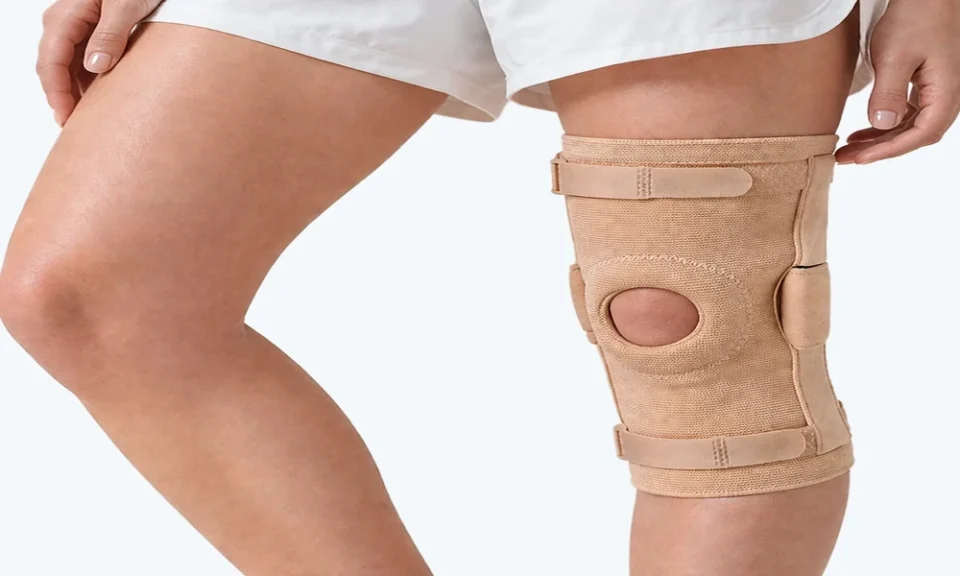
Knee support refers to a medical device used by those suffering with any kind of discomfort, stiffness, swelling, weakness or instability around the knee. Pain in the knees can totally lead to difficulty in even doing your routine tasks.
To relieve and stability the joint, there are two very popular options:
- Standard knee sleeves
- Hinged knee caps
Both are actually designed to offer a suitable support, however they function in different ways as well as are built to offer varying levels of knee support.
A standard knee sleeve concentrates on providing compression, warmth, comfort and enhanced proprioception to the joint. This support includes a lightweight and flexible material, making it suitable for everyday tasks and exercise when the knee remains reasonably stable.
On the other hand, hinged knee caps India feature side hinges that offer additional mechanical support as well as help to control excessive side-to-side movement of the knee.
So choosing between the two should vary less on which support product looks stronger and more on what kind of support your knee actually needs. Understanding the differences between both can totally help you make a more informed choice.
What Is a Standard Knee Sleeve?
Typically, the material of a standard knee sleeve India refers to elastic, stretched or knitted compressed material. The material fits comfortably snuggled as well as applies gentle, consistent compression around the knee. The slim construction allows full flexion of the knee as required.
What Refers to a Hinged Knee Cap?
A hinged knee cap India is actually a more structured form of knee support. It typically features hinges or sturdy supports on one or both sides of the knee. It also offers more stability than a standard compression sleeve.
A hinged design is typically considered when the knees feel weak or unstable. Particularly, following certain wounds or when the joint requires extra support. Moreover, depending on its design, it may still permit functional movement instead of completely immobilizing the knee.
Hinged Knee Cap or Standard Knee Sleeve: What are the Main Differences
| Feature | Hinged knee cap | Standard knee cap |
|---|---|---|
| Main purpose | Greater stability and movement control | Compression, comfort and general support |
| Support level | Moderate to high, depending on design | Mild |
| Construction | Fabric with side hinges or reinforcements | Stretchable compression material |
| Side-to-side stability | Better | Limited |
| Flexibility | Moderate | High |
| Range of motion | May provide some movement control | Generally allows near-full movement |
| Bulk | Usually higher | Usually low |
| Ease of wearing | May require straps or adjustments | Usually slides on like a sleeve |
| Everyday comfort | Depends on design and fit | Generally high |
| Suitable for unstable knees | More appropriate in some cases | Usually insufficient for significant instability |
| Suitable for light exercise | Yes, when appropriate | Yes |
| Breathability | Depends on construction | Generally good |
| Adjustability | Often higher | Usually limited |
A Practical difference: Compression Knee Sleeve vs Hinged Knee Cap
If your knee feels comfortable and stable, but still needs extra compression while performing any task, a sleeve might be adequate for you. In case your knee might feel give way or suddenly shift out of place. It could be more appropriate to speak with your doctor about stronger support.
Which Knee Support Should You Choose for Different Needs?
| Situation | Standard knee sleeve | Hinged knee cap |
|---|---|---|
| Mild knee discomfort | Yes | Sometimes |
| General compression | Yes | Yes |
| Everyday walking | Yes | Sometimes |
| Light exercise | Yes | Yes |
| Low-level swelling | Yes | Sometimes |
| Knee feels unstable | Limited | Yes |
| Need for side-to-side support | Limited | Yes |
| Previous ligament-related instability | Usually not enough | May be appropriate |
| Need for adjustable support | Limited | Yes |
What are the Advantages of a Standard Knee Sleeve?
- Lightweight as well as easy to wear.
- Provides compression and warmth.
- Allows considerable freedom of movement.
- Less bulky than a hinged support.
- Convenient for everyday activities.
- Can also offer proprioceptive feedback during movement.
- Also suitable when the knee is stable but needs mild additional support.
- Usually easier to wear underneath regular clothing.
What are the Benefits of a Hinged Knee Cap?
- A hinged knee cap offers more structural support than a sleeve.
- Provides extra side-to-side stability.
- Can provide a more secure feeling during movement.
- May be useful when the knee needs extra protection from unwanted movement.
- Adjustable designs can allow individuals to modify the fit.
- Can be considered during rehabilitation when recommended by a qualified healthcare professional.
- May be more appropriate for certain types of knee instability than a simple sleeve.
What Common Mistakes Should Be Avoided?
- Firstly, selecting the most rigid option simply as it appears to offer more protection.
- Assuming a knee sleeve can provide the same stability as a hinged brace.
- Wearing a knee support that is overly tight.
- Avoiding constant pain or repeated knee buckling.
- Using a brace as a substitute for appropriate rehabilitation.
- Selecting the wrong size.
- Continuing strenuous activity despite worsening symptoms simply because a support is being worn.
Last Thoughts
Individuals should opt for a standard knee sleeve if their primary goal is compression, warmth, comfort, proprioceptive input and minimal support during everyday activities without compromising flexibility.
A hinged knee cap India should be considered when greater stability or control of unwanted side to side movement is required.
Keep this in mind that the strongest knee cap support is not necessarily the right one. The ideal one should actually match the knee’s actual requirement, the activity being performed as well as the level of stability required.
Simply put, a standard knee sleeve is primarily designed for compression and comfort, whereas a hinged knee brace provides greater mechanical stability. Knowing the difference between the two helps you avoid choosing the wrong support, which would cause you not to be able to move easily and which would not provide you with adequate support.
