
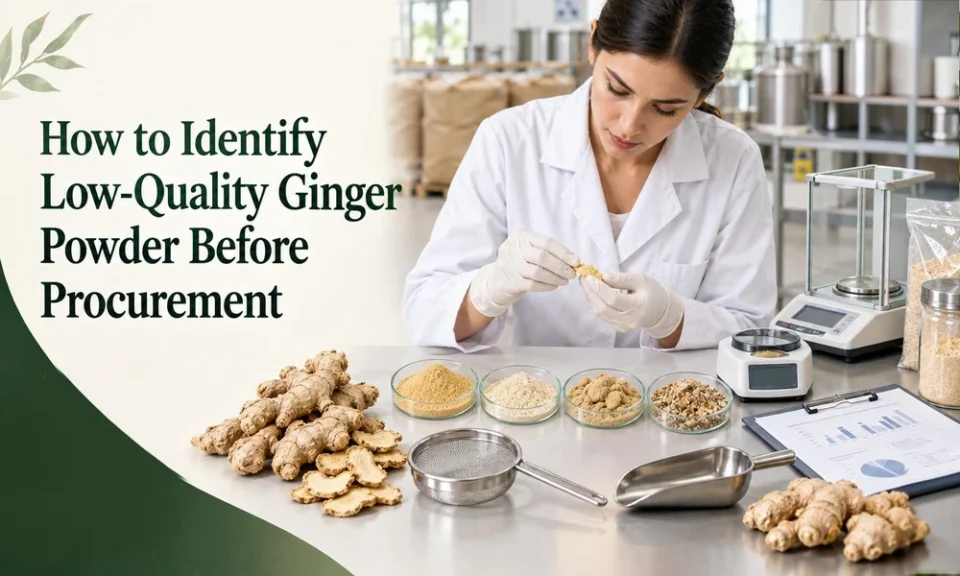
Ingredient quality issues in ginger powder are never very apparent but have important repercussions for formulation uniformity and finished-product performance. Ensuring that low quality ginger powderdoes not enter the supply chain is crucial for preserving the production schedule and label credibility. This post identifies the precise factors to be taken into account by procurement teams prior to approving a shipment.
The Cost of Getting Ginger Sourcing Wrong
Sourcing errors are costly well beyond the price of the material itself. A batch that fails potency testing after delivery typically results in reformulation delays and disrupted production schedules. Organizations managing bulk ginger powder procurement at scale benefit from establishing a standardized intake inspection process, since catching quality issues early is far less costly than discovering them after a batch has entered production.
Visual and Sensory Red Flags
Even before the laboratory test results have been reported, sensory evaluation still stands out as the most dependable method for initial screening. An effective ginger powder quality checkshould include color consistency, fragrance strength, and homogeneity of the substance across the sample. Unusual and inconsistent sensory properties often indicate that the material has been aged or blending, or otherwise compromised during processing.
Color, Aroma, and Texture Clues
Color is expected to vary only between light yellow and light tan; grey or excessively whitened shades are a warning sign. Aroma would be a more dependable factor as processed ginger has a pronounced, sharp smell upon opening. Buyers who have dealt with dried ginger whole slices before milling are aware that there is a difference because fresh slices have a pungent aroma, while degraded material has a flat or wood-like smell, lacking the characteristic citrus-pepper profile.
Low Gingerol / Weak Pungency
Pungency is directly tied to gingerol concentration, and diminished pungency is a strong indicator of reduced potency. Gingerol content ginger powder assays typically range between one and three percent, depending on variety and processing method. Suppliers unable to provide a documented assay figure, offering only general assurances of quality, have likely not conducted proper laboratory testing on the batch in question.
Excess Fiber, Spent Ginger, and Fillers
An increase in fiber content within a shipment often indicates that the root was either overused or blended with spent material remaining after oil extraction. Suppliers offering bulk ginger slice powder sourced from fresh, unprocessed rhizomes are generally better positioned to avoid this issue, as no residual extraction byproduct is introduced into the final grind. A gritty texture is frequently the first tactile indication of this problem.
Spotting Starch and Bran Adulteration
Starch fillers and bran dust are forms of adulteration that are relatively harder to detect. The most common form of ginger powder adulteration is that involving starch, which is normally characterized by an extremely smooth or chalky appearance and which can be confirmed using an iodine test because starch gives a unique bluish-black coloration which cannot be given by pure ginger.
High Ash and Foreign Matter
Apart from being aware of its sensory properties, the presence of ash gives one an indication of the level of cleanliness in the processing process. There needs to be an ideal ash content for ginger powder specificationwhich will define the acceptable levels of total ash and acid-insoluble ash, since higher levels of ash content usually indicate contamination by soil and poor post-harvest handling. The presence of visible stones, husks or plant matter in a sieve analysis also signifies inconsistent cleansing before milling.
Moisture and Poor Storage Signs
Moisture content constitutes a relatively less observable yet important risk factor. When powder is held at moisture content higher than what is suggested, the powder has a tendency to cake, clump, and form mold; this problem can be hard to detect until the entire batch or a significant portion has been affected. Checking the moisture content of the powder upon receipt will reveal this danger. By confirming moisture content at the intake point along with odor confirmation, the problem can be pinpointed at an early stage.
Microbial and Heavy-Metal Risks
Apart from microbial and heavy metal contamination, which are also hazards, but cannot be detected through sensory evaluation, the following criteria must be established for all incoming loads:
- Total plate count and yeast/mould levels within established limits
- Pathogen Testing for Salmonella and E. Coli
- Screening for Lead, Arsenic, and Cadmium against applicable Regulatory Thresholds
- Pesticide residue screening aligned with destination-market requirements
What to Ask For Before You Order
When making the final decision of placing an order, consumers should ask for documents that can prove their assertions rather than depending on marketing statements. The procurement department that concentrates on the process of checking the quality of ginger powder always focuses on how to test ginger powder quality and also consistently requests laboratory-certified information and reacts when the supplier fails to provide it.
CoA, Gingerol Assay, and Samples
A current Certificate of Analysis, an actual gingerol assay result, and a physical sample submitted ahead of the full order represent three essential requirements. A supplier unwilling to provide any of these should be regarded with appropriate caution.
A Pre-Procurement Ginger Checklist
Completing a structured checklist prior to placing an order helps identify most quality concerns early in the process:
- Verify gingerol content via an assay in the laboratory rather than a verbal estimate
- Compare color, smell, and texture with that of a good quality reference sample
- Ask for a Certificate of Analysis, moisture, ash, and microbial test report of the particular batch
- Identify season of harvest, source, and whether the stock is current or carried over
Frequently Asked Questions
Q: How can I tell if ginger powder is low quality?
A: Observe color, aroma, and texture of the product first. If the color is white, lack of smell, and rough texture are usually the characteristics of old, adulterated or poorly processed material.
Q: What is ‘spent’ ginger and why does it matter?
A: Spent ginger is root material remaining after oil or oleoresin extraction, sometimes reused as filler. It carries weak pungency and lower gingerol content than fresh material.
Q: How is ginger powder adulteration detected?
A: Starch and bran fillers are normally identified by their uniquely smooth and chalky appearance, and this can easily be verified using an iodine test that gives a blue-black color response.
Q: What gingerol level indicates good ginger?
A: Quality ginger powder generally assays between one and three percent gingerols, depending on variety and processing. Buyers should request laboratory-verified figures, not estimates.
Q: What documents should I request before procurement?
A: Request a Certificate of Analysis, gingerol assay results, moisture and ash data, and a physical sample for independent verification prior to placing a full order.
Sourcing Reliable Ginger Powder
The reliability of sources requires documentation transparency , rather than assumption of trustworthiness.In most cases, the supplier who accepts scrutiny, answers queries related to testing, and provides samples readily is the better supplier to be associated with, independent of price considerations alone.
